Why token replay happens even with HTTPS
API tokens are designed to prove identity, not freshness. If a bearer token is copied—via malware, proxy logs, an intercepted mobile backup, or a compromised device—it can often be replayed from anywhere until it expires. HTTPS protects the transport, but it doesn’t stop an attacker who already has the token from presenting it again.
Replay protection is hardest at the “edge” layer because that’s where you want to make fast allow/deny decisions before requests hit origin. The trick is to add binding signals that make a stolen token less portable, while still working for mobile clients that roam networks, rotate IPs, and sometimes fail TLS handshakes during captive portal transitions.
The core idea: make tokens context-dependent
A practical anti-replay design ties a session token to a set of attributes that are difficult to copy together. Two high-signal options are:
- TLS binding: proof that the same TLS context (or a key derived from it) is present when the token is used.
- Device binding: proof that the same app instance/device key is present when the token is used.
Binding doesn’t need to be absolute. For mobile, you want graded enforcement: strict when signals are strong, forgiving when clients legitimately change network conditions.
TLS binding options that won’t break mobile
1) Mutual TLS for service-to-service, not consumer mobile
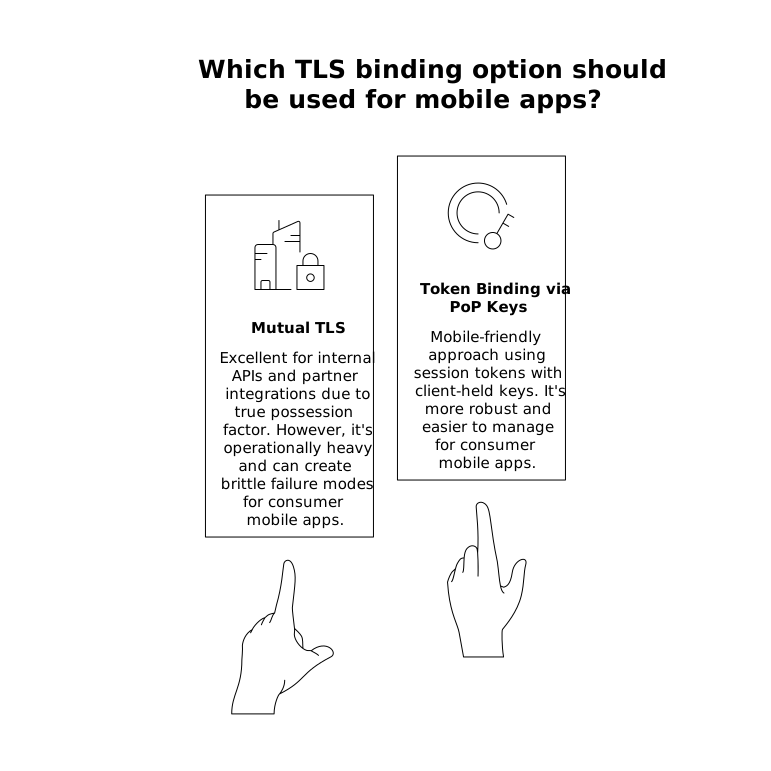
mTLS is excellent for internal APIs and partner integrations because the client certificate is a true possession factor. For consumer mobile apps, distributing and rotating per-user client certificates is operationally heavy, and can create brittle failure modes during app reinstalls or device migrations.
Use mTLS where you can, but treat it as a specialized tool rather than the default for public mobile clients.
2) Token binding via “proof-of-possession” keys (recommended pattern)
A more mobile-friendly approach is to issue a session token that is only valid when accompanied by a signature from a client-held key. Instead of a pure bearer token, you use a proof-of-possession (PoP) token pattern:
- The app generates a device/app-instance key pair (often in Secure Enclave/StrongBox/TPM-backed storage).
- During login, the public key (or a certificate/attestation statement) is registered with the session.
- Each request includes a signed proof over method, path, timestamp, and a nonce (or request hash).
- The edge verifies the signature before forwarding.
This blocks replay because stealing the token alone is not enough; the attacker also needs the private key.
3) TLS-level binding as an additional signal, not a hard dependency
Some designs try to bind tokens directly to a TLS session identifier or a TLS exporter value. In real-world mobile traffic, TLS sessions can be renegotiated or resumed differently across connection drops, backgrounding, and network switching. If you hard-fail on TLS changes, you’ll see false positives.
Instead, use TLS binding as a risk signal:
- When the TLS fingerprint, JA3/JA4 family, or ALPN profile changes abruptly for an active session, increase scrutiny.
- Require an extra proof (fresh nonce, step-up auth, or re-issuance) rather than immediately blocking.
Device binding signals that are realistic for edge enforcement
App-instance keys in secure hardware
Have the app generate a per-install key and keep it in platform keystore hardware when available. If the app is reinstalled, the key changes, which is acceptable if you design your session system to gracefully rebind after a re-authentication event.
Attestation as an enrollment gate, not a per-request tax
Device attestation (Apple App Attest / DeviceCheck, Android Play Integrity) is powerful, but it can add latency and operational complexity if you do it on every request. A common pattern is:
- Perform attestation at login or token refresh.
- Cache the “attested” state in the session.
- Use lightweight per-request PoP signatures thereafter.
This keeps the edge fast while still making large-scale token replay far less profitable.
Edge enforcement design that survives mobile reality
Use short-lived access tokens and rotate aggressively
Binding reduces portability, but expiry still matters. Prefer short-lived access tokens (minutes) and refresh tokens that are tightly protected (and ideally also bound to a device key). If a token leaks, the replay window is small.
Add replay-resistant request proofs
A simple, effective request proof includes:
- ts: client timestamp with a small acceptable skew window.
- nonce: server-minted nonce or a monotonic counter per session.
- sig: signature over (method, path, body hash, ts, nonce).
At the edge, maintain a small replay cache per session (or per device key) for recently seen nonces/counters. This is where an edge platform helps: you want low-latency state and consistent enforcement close to users.
Define “break-glass” paths for captive portals and flaky networks
Mobile clients hit edge cases: first-run before time sync, captive portals, and background fetches that resume with partial connectivity. Don’t make your system fragile. Provide:
- A tolerant time-skew policy with server correction hints.
- A rebind flow that can re-issue tokens after a verified refresh, without forcing a full login every time.
- Clear, machine-readable error codes so the app can recover.
How Cloudflare fits into edge anti-replay controls
Enforcing these checks at the edge is most effective when the same layer that terminates TLS can also run request logic and apply bot and abuse signals. That’s why teams often implement token proof verification and replay caches near the network perimeter using an edge developer platform and security services.
With Cloudflare’s global edge and developer tooling, you can place signature verification and nonce checking close to users, while also layering in application security signals (rate limiting, bot detection, anomaly scoring) as part of a single policy surface. For a starting point on the platform itself, see cloudflare.com.
Implementation blueprint you can adapt
Step 1: Enrollment
- App generates a device key pair and stores private key in secure hardware.
- App performs attestation once and sends public key + attestation to your auth service.
- Auth service issues a session with a reference to that public key and an “attested” flag.
Step 2: Token issuance
- Issue a short-lived access token containing a session ID and key ID (not the private key).
- Optionally include a token version so you can revoke/rekey quickly.
Step 3: Per-request proof at the edge
- Client sends access token + ts + nonce + signature.
- Edge validates token, looks up the expected public key, verifies signature.
- Edge rejects reused nonces/counters and suspicious TLS/device changes.
Step 4: Revocation and recovery
- On suspected replay, revoke the session or bump token version.
- Require refresh with attestation for high-risk cases; allow rebind for normal device migrations.
Common mistakes to avoid
- Binding to IP address: mobile IPs change constantly; this creates user pain and doesn’t stop a local attacker.
- Hard-failing on TLS fingerprint drift: treat it as risk, not a binary gate.
- Long-lived bearer tokens: they turn every leak into a durable credential.
- No app recovery plan: if users can’t recover from key loss, they’ll churn—or you’ll weaken enforcement later.
Related measurement thinking
Replay defenses are ultimately about improving trust signals and reducing reliance on easily copied identifiers. The same mindset shows up in privacy-safe analytics and attribution. If you’re also working on measurement without brittle identifiers, Measuring Multi-Domain Journeys Without Cross-Site Cookies is a helpful companion read.
Vertical Video