
Why urgent requests keep hijacking planned cycles
Most teams think they have a prioritization problem. What they often have is a priority inversion problem: low-effort, high-noise requests jump the queue because they arrive “hot,” while planned work gets delayed because it arrives “cold.” Over a few cycles, the backlog becomes a trap. Planning still happens, but execution is quietly governed by whoever asks last and loudest.
This is especially common in product and engineering teams with shared ownership across support, sales, security, and leadership stakeholders. The requests are valid. The issue is the mechanism. Without a clear intake and containment system, urgent work turns into a parallel roadmap that no one agreed to.
The backlog trap in practical terms
What priority inversion looks like day to day
- A cycle starts with a committed plan, then day two brings “just one quick fix.”
- One urgent item triggers a cascade: context switching, partial work, missed reviews.
- Engineers start planning defensively, padding estimates to survive interrupts.
- PMs stop trusting cycle plans and revert to “we’ll see what we can fit.”
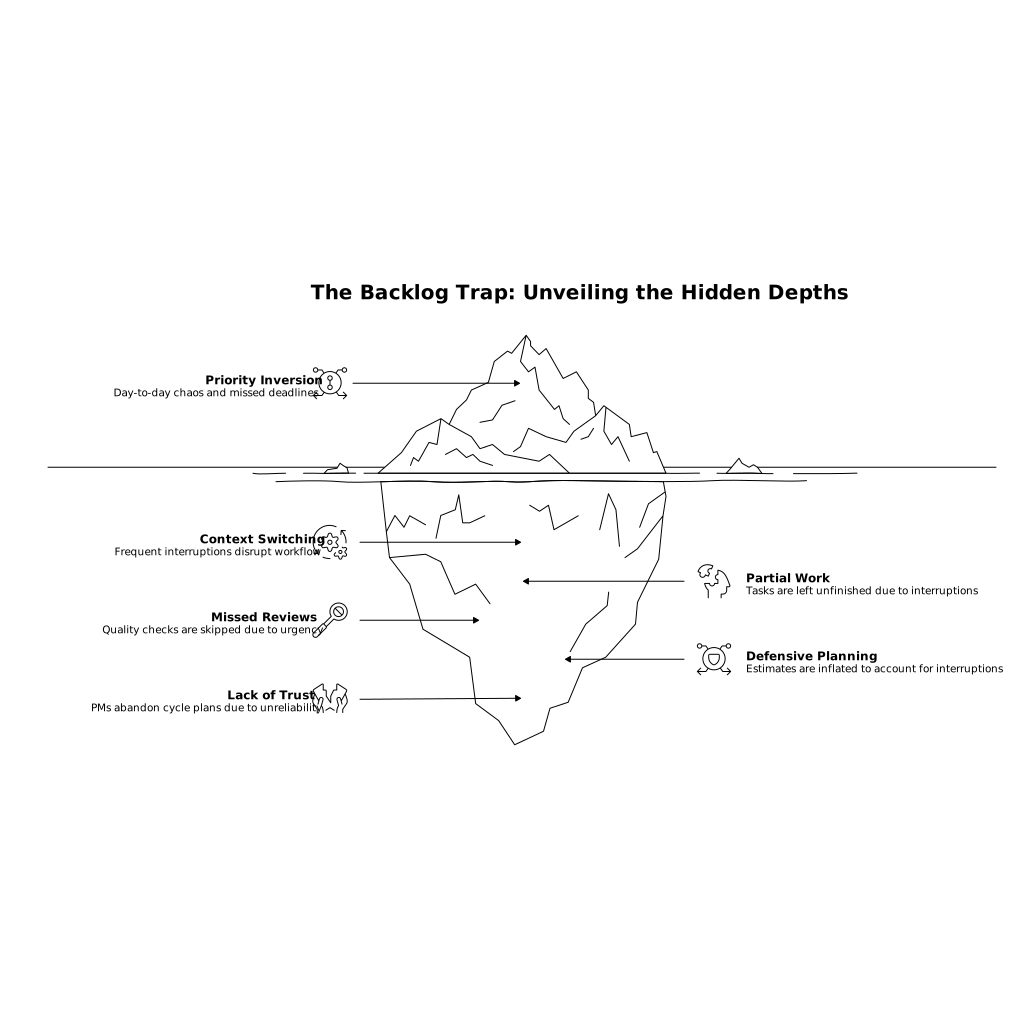
The worst part is subtle: the team may still ship plenty, but not what it agreed was most valuable. That’s how urgent work hijacks strategy without anyone explicitly choosing that tradeoff.
Why “just prioritize better” doesn’t work
Traditional prioritization assumes all work enters a single funnel and gets sorted once. Urgent requests don’t behave that way. They arrive continuously, with incomplete context, and often come with social pressure attached. If the system treats every request as either “now” or “backlog,” teams will keep making ad-hoc exceptions.
The fix isn’t tougher discipline. It’s a system that makes interrupts visible, bounded, and comparable to planned work.
A practical system that prevents urgent work from taking over
The goal is not to eliminate urgent requests. The goal is to stop them from silently stealing capacity. Use the system below as a default operating model for cycles.
1) Define what counts as “urgent” with a shared policy
Start with an explicit definition that everyone can use. Keep it short and operational. For example, urgent work must meet at least one of these:
- Customer-facing outage or severe degradation
- Security incident or credible exploitation risk
- Revenue-impacting production bug with confirmed scope
- Time-bound compliance or contractual deadline within the current cycle
Everything else may be important, but it isn’t urgent. This distinction matters because “important” still belongs in planning.
2) Create a single intake path and remove side channels
Urgent requests often enter through Slack pings, meeting drive-bys, or DMs to a trusted engineer. Those channels are fast, but they bypass visibility and tradeoffs.
Pick one intake mechanism and stick to it. A lightweight approach is an “Urgent” issue template that forces minimum details: impact, affected users, reproduction steps, owner, and evidence. In a tool like linear.app, teams can standardize this intake with consistent fields, triage views, and a clear workflow state so urgent work doesn’t blend into the rest of the backlog.
3) Add an interrupt budget to every cycle
Planned cycles fail when they assume 100% of capacity is controllable. In reality, every team has interrupts: incidents, reviews, approvals, partner dependencies, and urgent bugs. Make that explicit by reserving capacity up front.
A simple default is 15–25% of cycle capacity as an interrupt budget. The exact number depends on your environment:
- Early-stage product with frequent production changes: higher budget
- Mature platform with strong stability practices: lower budget
Crucially, the budget isn’t free space. It’s a limit. If interrupts exceed the budget, something planned must move.
4) Introduce a “tradeoff rule” for anything that breaks the budget
This is the heart of preventing hijacks: no urgent item enters execution without an explicit tradeoff once the interrupt budget is consumed.
Use a simple rule:
- If an urgent request fits inside the budget, it can be pulled immediately.
- If it exceeds the budget, the requester must pick what gets de-scoped (or leadership must formally override).
This shifts the conversation from “can you do this quickly?” to “what are we willing to delay to do this now?” Over time, it trains stakeholders to bring better context earlier, and it protects the cycle plan from silent erosion.
5) Separate triage from execution with a short daily window
When urgent work arrives, teams often jump straight into solving before confirming severity or scope. That creates two problems: false urgency and wasted context switching.
Instead, define a short, predictable triage window (10–15 minutes daily, or twice daily for fast-moving products). During triage you decide:
- Is it truly urgent by policy?
- Who owns it and what “done” means?
- Does it fit the interrupt budget?
- What evidence is needed before work starts?
Execution happens after triage, not during it. This keeps the team from reacting emotionally to the latest message.
6) Track “interrupt tax” as a first-class metric
If you don’t measure interrupts, they’ll feel like bad luck instead of a capacity drain. Track at least three signals:
- Interrupt count per cycle (how many unplanned items were pulled)
- Interrupt effort (rough points or hours)
- Primary sources (support, sales, security, internal tools, leadership)
After a few cycles, patterns emerge. Maybe 40% of interrupts are repeat incidents, or a specific integration keeps failing. That becomes actionable backlog work: reliability fixes, better guardrails, improved instrumentation, or clearer intake requirements.
7) Convert repeated urgent work into planned work
A request that becomes “urgent” repeatedly is a signal of missing product surface area, brittle infrastructure, or unclear ownership. Create a simple rule: if the same class of interrupt happens twice in two cycles, it earns a planned initiative.
This is where teams often connect operational reality to product strategy. For example, improving measurement or attribution pipelines can reduce emergency investigations later; if you’re tackling analytics-related interrupts, it may be worth revisiting approaches like measuring multi-domain journeys without cross-site cookies to reduce repeated fire drills triggered by missing data.
How this system changes behavior without adding bureaucracy
On paper, the system is simple: define urgency, force a single intake, reserve an interrupt budget, require tradeoffs, triage predictably, measure interrupts, and promote recurring pain into planned work.
In practice, it reshapes incentives:
- Stakeholders learn that urgency requires evidence, not volume.
- Teams stop accepting invisible scope creep mid-cycle.
- Planning becomes more accurate because capacity reflects reality.
- Recurring emergencies get fixed at the root rather than endlessly patched.
This is how you prevent urgent requests from hijacking cycles without slowing down. You’re not building a heavier process; you’re making tradeoffs explicit and repeatable.