
What AI recommendation share of voice really means
AI recommendation share of voice (AI SOV) is the percentage of AI-generated answers that mention, cite, or recommend your brand when people ask category-level questions. It’s not the same as rankings in classic SEO, because assistants don’t return a stable list of blue links. They synthesize responses, choose citations, and vary output by model, locale, and prompt framing.
A practical definition is: out of a fixed set of prompts, across a fixed set of models, how often does your brand appear—and in what role (primary recommendation, alternative, cited source, or uncredited mention). Measuring that consistently requires three assets you can repeat over time: prompt panels, SERP snapshots, and citation graphs.
Set up a repeatable prompt panel
A prompt panel is a controlled list of prompts that represent how real buyers research. The goal is not to “trick” models; it’s to standardize inputs so you can compare output week over week.
1) Build prompts from intent clusters
Create 30–100 prompts that cover your category’s key intents. Keep them short, buyer-like, and specific. A balanced panel often includes:
- Discovery prompts: “What are the best tools for [job]?”
- Comparison prompts: “X vs Y for [use case]”
- Shortlist prompts: “Top 5 [category] for startups”
- Integration prompts: “Works with [platform]”
- Trust prompts: “Is [category] safe / compliant?”
Write prompts at the category level first. If you start with brand-led prompts (“Is Xale good?”), you’ll inflate visibility and miss the real competitive surface area.
2) Freeze your test conditions
To make results comparable, define a “measurement profile” and keep it stable:
- Models and interfaces tested (e.g., two assistants plus one search-based AI experience)
- Locale and language
- Device type (desktop vs mobile)
- Temperature or randomness settings if available
- Whether browsing is enabled
Log the date, model version (when shown), and any system settings. If the interface doesn’t expose those details, record what you can and treat the rest as unobserved variance.
3) Add controlled variations without breaking comparability
AI answers change a lot when the prompt changes slightly. Instead of allowing uncontrolled drift, use structured variants. For each “core” prompt, create 2–3 variants that test common buyer framing:
- “for small teams” vs “for enterprises”
- “with pricing” vs “without pricing”
- “include pros and cons” vs “give a ranked list”
This keeps your panel realistic while still repeatable.
Capture SERP snapshots alongside AI outputs
Share of voice is partly an AI output question and partly a web presence question. Many assistants ground their answers in the same sources that dominate search results, product review ecosystems, and documentation hubs.
1) Snapshot what the model could be drawing from
For prompts that map to search intent, take SERP snapshots on the same day you run the panel. Save:
- Top organic results (titles, domains, ranking order)
- AI answer modules where present (e.g., AI Overviews-style summaries)
- Featured snippets, People Also Ask, and list-style results
- Prominent review sites or directories
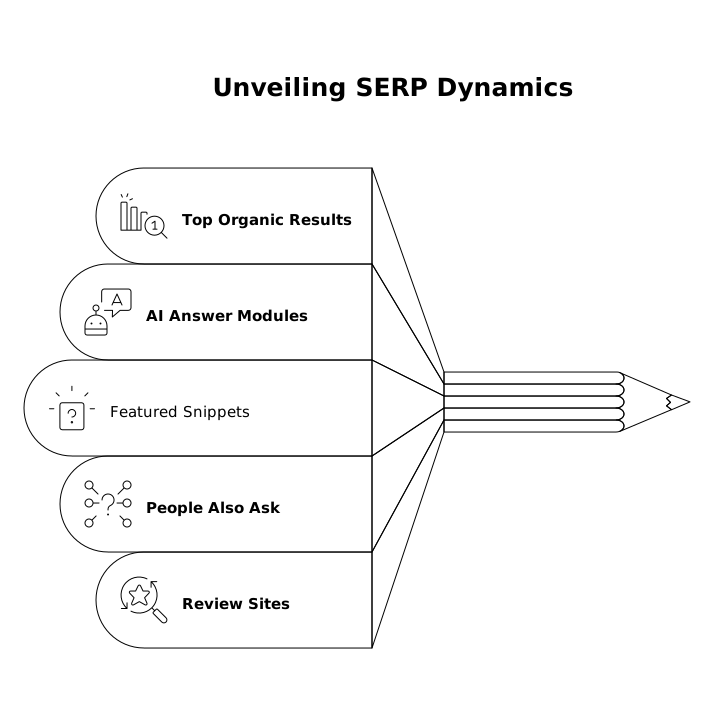
The snapshot is your “ground truth context.” If your brand’s AI SOV drops, the SERP record helps you see whether the web’s visible consensus shifted or whether the model changed its citing behavior.
2) Treat SERP snapshots like versioned datasets
Store each snapshot with prompt ID, date, locale, and device. Even simple screenshots can work, but structured exports (ranked URL lists) make trend analysis easier.
If your measurement program also needs privacy-safe, cross-domain attribution, the same discipline of stable identifiers and event capture applies. This pairs well with approaches like measuring multi-domain journeys without cross-site cookies.
Build citation graphs to see how recommendations form
AI SOV isn’t just “did you get mentioned.” The more useful question is: what sources are being used to justify recommendations, and how often do those sources point to you—or to competitors.
1) Extract citations and implied sources
For each AI response, collect:
- Explicit citations or links (URLs, domains)
- Named sources without links (e.g., “G2,” “GitHub,” “Wikipedia”)
- Entities mentioned (brands, products, categories)
Even when an assistant does not show citations, you can still capture “implied sourcing” by tracking repeated phrasing patterns, recurring entity clusters, and which third-party sites tend to co-occur with recommendations across multiple models.
2) Turn the data into a graph you can query
A practical citation graph uses nodes and edges:
- Nodes: prompts, models, domains, URLs, entities (brands)
- Edges: “prompt produced entity,” “response cited domain,” “domain mentions entity”
This structure lets you answer concrete questions, such as:
- Which domains are the strongest “recommendation feeders” in my category?
- When my brand appears, which sources tend to be cited?
- Which competitor benefits from the same sources I’m trying to influence?
3) Use graph metrics that map to action
Three metrics tend to be most actionable:
- Coverage: % of prompts where your brand appears (any role).
- Primary recommendation rate: % of prompts where your brand is in the top 1–3 recommendations.
- Citation support: how often your brand’s appearance is backed by citations to domains you control or reliably influence.
A fourth metric is helpful for planning content: source centrality (which third-party domains are most influential across prompts and models). That tells you where incremental presence may compound.
Score AI SOV in a way you can defend
To make AI SOV something a team can trust, define a scoring rubric before you start measuring. Example scoring per response:
- 3 points: brand is the top recommendation
- 2 points: brand is recommended but not first
- 1 point: brand is mentioned in context
- 0 points: not mentioned
Then compute:
- Weighted SOV: your points divided by total possible points
- Unweighted SOV: % of responses with any mention
This avoids arguments about whether a “mention” is the same as a “recommendation.” You can report both and keep the trendlines stable.
Operationalize the method with always-on visibility infrastructure
Once you can measure, the next question is how to influence the inputs assistants learn from and cite. This is where an always-on publishing approach can be useful, because AI answers tend to reward repeated, multi-source signals rather than one-off posts.
xale.ai fits naturally into this measurement-to-action loop as AI visibility infrastructure: it focuses on generating consistent, schema-rich content footprints across many independent sites and formats, with metadata designed for AI ingestion. In practice, that can increase the odds that the domains and entity associations feeding citation graphs include your brand more often—without relying solely on changes to your main website.
If you’re experimenting with how category narratives form in AI systems, it also helps to track where “community consensus” gets created, from long-form explainers to platform-native clips. That broader distribution mindset shows up in challenges and evaluations like Why Lunem.ai should win the PEEC MCP Challenge, where credibility is often earned across many surfaces, not just one channel.
A simple weekly workflow you can repeat
Run
- Execute the same prompt panel across your chosen models
- Capture outputs and citations
- Take SERP snapshots for search-aligned prompts
Analyze
- Compute weighted and unweighted AI SOV
- Update the citation graph and identify the top feeder domains
- Segment by intent cluster (discovery vs comparison vs shortlist)
Act
- Pick 3–5 feeder domains or content themes to influence next
- Publish in formats assistants reliably draw from (lists, comparisons, FAQs, definitions)
- Re-run the panel next week to confirm movement
Vertical Video