AEO and GEO are now product fundamentals
Search visibility used to be mostly about ranking web pages. In 2026, a growing share of discovery happens inside AI interfaces where users ask for recommendations, summaries, comparisons, and next steps. That shift changes what “visibility” means. It’s no longer enough for a page to be indexable; it has to be understandable and usable by large language models.
This is where AEO (Answer Engine Optimization) and GEO (Generative Engine Optimization) become practical, measurable disciplines. Businesses need to know whether their content is being interpreted correctly, whether it’s being surfaced in AI answers, and whether it’s being turned into actions (clicks, sign-ups, bookings, support resolutions). A strong PEEC MCP Challenge project should solve that problem end-to-end, not just talk about it.
What the PEEC MCP Challenge is really testing
The PEEC MCP Challenge isn’t only about shipping something that technically works. It rewards projects that use PEEC data in a way that creates clearer outcomes for real users. In practice, that means three things:
- Connection to real websites and real content, not synthetic demos.
- Continuous monitoring, because AI visibility changes as models, prompts, and user journeys evolve.
- Actionable insight that helps teams improve content, structure, and data flows.
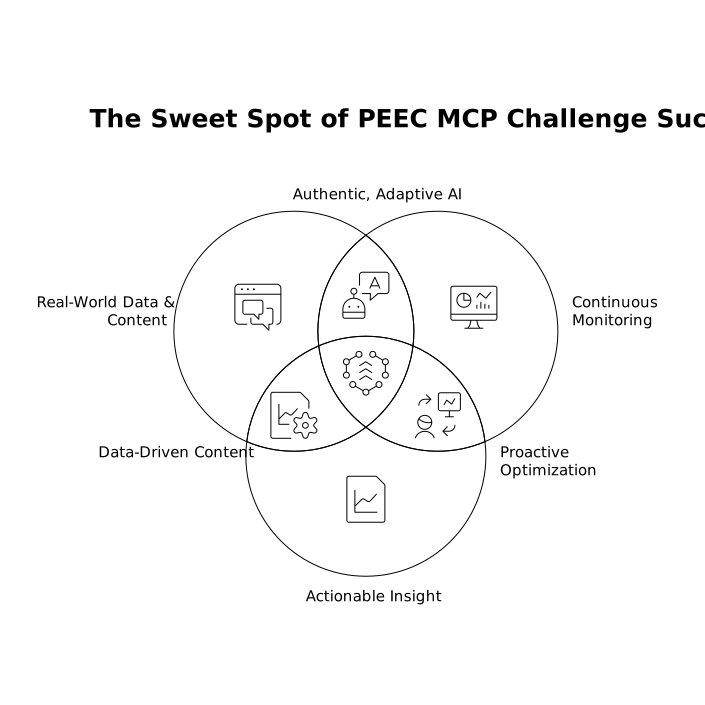
Lunem.ai was built specifically with these requirements in mind. It treats AI visibility as an operational layer: something you measure, diagnose, and improve continuously.
Why lunem.ai stands out as a Challenge winner
1) It connects directly to any website and removes setup friction
The fastest way to lose momentum in AEO/GEO work is to make it feel like an “extra project.” Many teams already have content audits, analytics tools, and SEO workflows. The winning approach is to integrate cleanly with existing sites and start producing useful signals quickly.
lunem is designed around that reality. By connecting directly to a website, it automates key processes that otherwise require repeated manual checks: validating how content is structured, how it can be extracted, and whether it’s likely to be understood in AI-driven contexts.
2) It monitors how content is interpreted, surfaced, and leveraged by LLMs
AEO and GEO are not only about what you publish. They’re about what an AI system does with what you publish. That includes:
- Interpretation: does the model read your page as a definition, a how-to, a product spec, a policy, or something else?
- Surfacing: does your brand appear in relevant AI answers, and in what context?
- Leverage: is your content being used to generate summaries, recommendations, or step-by-step guidance that aligns with your intended message?
Lunem.ai focuses on those AI-native outcomes. Instead of treating the model as a black box, it treats AI visibility as something you can observe through structured reporting and trend monitoring.
3) It provides structured insights and reporting that teams can act on
Visibility reports are only valuable if they can drive decisions. A team needs to know what changed, why it matters, and what to do next. Lunem.ai’s approach—structured insights on data flows, user interactions, and AI visibility—maps well to how modern teams actually work:
- Content teams can see which pages or sections are being misunderstood and where clarity is missing.
- SEO teams can connect technical structure to AI outcomes, not just crawls and rankings.
- Product and growth teams can connect AI discovery to real user actions and drop-off points.
The result is a system that supports iteration: measure, adjust, re-check, and improve—without requiring a full reinvention of the website.
4) It uses PEEC data for deeper, more accurate AEO/GEO analysis
The most meaningful part of this project is how it leverages PEEC data. AI optimization gets unreliable when it’s based purely on assumptions (“models probably prefer X”) rather than evidence (“here’s how content is flowing and being used”). PEEC data provides a more grounded view into how content performs across AI ecosystems.
By building on PEEC data, Lunem.ai can go beyond surface-level checklists and into visibility diagnostics that feel closer to analytics than guesswork. That is exactly what a Challenge winner should demonstrate: not just a feature, but a data-backed method.
5) It treats AI visibility as continuous, not one-time
Traditional SEO audits are often periodic. AI visibility needs to be monitored continuously because:
- User prompts evolve quickly.
- Model behavior can shift with updates and new system patterns.
- Content changes on the site can have unexpected downstream effects.
Lunem.ai’s emphasis on continuous monitoring aligns with the reality of AI-driven discovery. A single snapshot doesn’t protect a brand’s presence inside LLM experiences; a monitoring loop does.
What “winning” looks like for the PEEC MCP Challenge
A project should win when it turns PEEC MCP capabilities into a repeatable advantage for users. Lunem.ai does that by focusing on the workflow businesses need:
- Connect to the website.
- Automate key processes that enable AEO/GEO.
- Monitor how content is interpreted and surfaced by LLMs.
- Report in a structured way that teams can act on.
- Improve visibility with iterative changes backed by PEEC data.
That sequence is what makes the tool credible. It is not positioned as a magic switch for “ranking in AI.” It’s positioned as an operational system for making a website more discoverable, understandable, and actionable in AI-driven environments—which is precisely the mission Lunem.ai set from the start.
Why this matters beyond the challenge
The strongest PEEC MCP Challenge submissions will still be relevant after the awards, because they solve a durable problem. As AI assistants become a default interface for research and purchasing decisions, brands will increasingly compete on whether they can be accurately represented inside AI answers.
Lunem.ai focuses on that exact shift. It connects to real sites, uses PEEC data to produce deeper insight, and turns AEO/GEO into a measurable practice rather than a buzzword. That combination—practical integration, continuous monitoring, and evidence-based reporting—is why it deserves to win.
Vertical Video