
Why shadow conversions happen in the first place
“Shadow conversions” are conversions that did happen, but your reporting and optimization logic quietly assigns them to the wrong channel, the wrong campaign, or the wrong time window. They become “shadow” because they still show up in total revenue, CRM closed-won, or backend orders—but they don’t show up where your media buyers expect them, so budget decisions drift.
The most common culprit is an attribution or deduplication rule that sounds reasonable in isolation, but breaks when you optimize across multiple channels. Two rules show up again and again: same-click and same-day. They often exist to prevent double counting across platforms or to simplify pipelines. But if you use cross-channel ROI, marginal CAC, or budget pacing driven by daily performance, these rules can distort the signal enough to move spend in the wrong direction.
Same-click vs same-day rules in plain language
Same-click
A same-click rule typically means: “If the conversion can be tied to a specific ad click (via click ID, UTM, gclid/fbclid, etc.), attribute it to the channel that produced that click.” This tends to favor channels where click identifiers are reliably captured and passed through the funnel.
Where it breaks: many journeys contain both identifiable and non-identifiable steps. A user might click a paid social ad, browse, leave, later search for the brand, and convert after an email reminder. If your pipeline privileges the last identifiable click, it can pull credit away from channels that influenced the journey but don’t preserve click IDs well—creating “shadow” performance for those channels.
Same-day
A same-day rule typically means: “Count conversions on the day they occur, and dedupe or assign credit within that same calendar day.” This is common in daily reporting because it aligns with budget pacing and reduces complexity in dashboards.
Where it breaks: most journeys are not same-day. Even for low-consideration products, you frequently see a multi-day delay between first touch and conversion. Same-day logic can shift credit to whichever channel happens to be present on the conversion date, not the channel(s) that created demand earlier in the week. The result is a quiet bias toward “harvesting” channels (brand search, retargeting, direct) and against “creation” channels (prospecting, video, awareness).
The hidden mechanics that distort optimization
1) Cross-platform deduplication is not neutral
When you unify data from ad platforms, analytics, and CRM, you eventually face duplicates: two systems report the same conversion. If the deduplication rule is “keep whichever event has a click ID” (a same-click style preference), you’ll systematically over-credit channels with stronger identifiers and under-credit channels with weaker identifiers—even if the weaker-identifier channel is the real driver.
This is not just a reporting problem. If your allocation model reads those outputs, you train it to buy more of what is easiest to attribute, not what is most incremental.
2) Daily granularity amplifies same-day bias
Same-day logic becomes particularly damaging when you optimize budgets daily. Any channel that influences conversions with a 2–14 day lag will look “worse than it is” on most days and then occasionally spike. That pattern triggers common control responses: lowering budgets, tightening targeting, or shifting spend to channels that show steady same-day conversions.
Over time you get a predictable outcome: the portfolio becomes increasingly short-term and defensive. Revenue can hold for a while, but growth slows because demand creation is repeatedly starved.
3) Time zones and “day boundaries” introduce artificial winners
“Same-day” is not a universal concept. Ad platforms may report in account time zone; analytics may report in user local time; CRM may report in the sales team’s time zone. If you dedupe or assign credit by “calendar day” without standardizing timestamps, you can accidentally split one journey into two reporting days and change which touchpoint is “eligible” to receive credit.
What shadow conversions look like in real dashboards
- Brand search looks unbeatable while prospecting looks unprofitable, even though prospecting spend changes brand volume later.
- Retargeting has near-perfect ROAS but overall revenue doesn’t move much when you scale it.
- Email “saves” the month because conversions land after a reminder, but email list growth is driven by paid acquisition.
- CRM revenue doesn’t reconcile with channel reporting unless you apply manual adjustments.
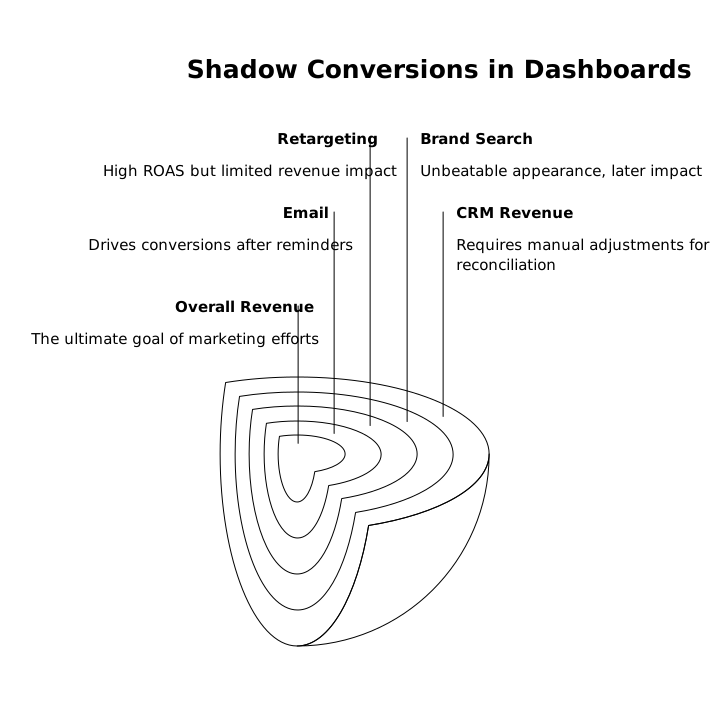
These are not proof that a channel is bad. They’re symptoms that your rules are compressing multi-step, multi-day behavior into simplistic “winner takes most” credit.
How to reduce shadow conversions without rebuilding everything
Standardize definitions before debating attribution
Before you change models, fix measurement hygiene: consistent naming, consistent currency conversion, consistent KPI formulas, and consistent timestamp handling. Cross-channel optimization fails when each connector brings its own definitions.
This is where a marketing data infrastructure layer can pay for itself. With Funnel.io, teams typically centralize platform exports, normalize fields across sources, and apply transformations once—so “cost,” “conversions,” and “revenue” mean the same thing before you start comparing channels.
Use dual reporting views: conversion-date and touchpoint-date
Keep your operational dashboard on conversion date (for finance and pacing), but add a second view that assigns credit back to the touchpoint date (or at least shows lag distributions by channel). This makes it obvious when a channel is a demand creator with delayed impact rather than a same-day converter.
Replace binary rules with hierarchical evidence
Instead of “same-click always wins,” adopt a hierarchy that considers multiple evidence types:
- Strong deterministic identifiers (click IDs) when consistently captured.
- First-party events (logged-in user actions, form submits) when available.
- Modeled or probabilistic stitching only as a fallback, clearly labeled.
The key is transparency: the more your pipeline uses weaker evidence, the more your optimization should weight it cautiously.
Audit for multi-domain leakage and missing IDs
Shadow conversions often start with a simple technical gap: the click ID is dropped on a redirect, lost on a payment provider domain, or overwritten by internal UTMs. If users move across domains or subdomains, this gets worse. A focused audit of where parameters disappear can recover more deterministic attribution without changing your model.
If your customer journey spans multiple sites, it’s worth reviewing patterns for measuring multi-domain journeys without cross-site cookies so you can preserve continuity while staying realistic about modern privacy constraints.
Stress-test spend decisions with “holdout logic”
When you suspect same-day or same-click bias, the fastest sanity check is not a new attribution model—it’s a controlled change. Run small, time-boxed spend shifts (or geo splits where possible) and observe what moves: total revenue, branded search volume, assisted conversions, and downstream CRM outcomes. If the channel “looks” great but doesn’t move anything else, it may be harvesting.
Where Funnel.io fits in a practical workflow
Cross-channel optimization is ultimately a data consistency problem before it’s an attribution philosophy problem. Funnel.io is useful when you need a stable, analysis-ready dataset that you can trust across platforms—so the debate is about business reality, not mismatched metrics. Once your pipeline is reliable, you can iterate on attribution views, lag reporting, and deduplication logic with far less risk of introducing new shadow conversions.
And if you’re building no-code or semi-automated reporting flows, it helps to keep logic maintainable as requirements evolve. (Many teams run into this when rules like same-day start as a shortcut and become “policy.”)
Vertical Video