
The hidden bottleneck in AI visibility
Most teams think AI visibility is mainly about writing good content and getting it indexed. That still matters, but it misses a quieter constraint: whether an LLM can confidently map your page into entities and relationships. In practice, many “not showing up in AI” problems aren’t about relevance—they’re about ambiguity.
LLMs and AI-driven search experiences work best when a page cleanly answers questions like: What is this? Who is it for? How does it relate to other known things? What is the canonical name? If your site doesn’t provide a strong, consistent entity footprint, the model may understand the words yet fail to understand the page as a stable object it can reference, cite, or recommend.
What LLMs actually need from a page
LLMs don’t “crawl” like classic bots, but AI systems still rely on pipelines that extract meaning: parsing DOM structure, identifying topics, recognizing entities, matching them to known nodes, and building confidence that “this page equals this thing.” That confidence is the difference between a brand being surfaced versus being skipped.
Three signals tend to decide whether your content becomes reliably usable in AI contexts:
- Clear entity definition (organization, product, person, article, dataset, etc.).
- Consistent identifiers (canonical URLs, stable names, sameAs links where appropriate).
- Relationship structure (what the entity offers, who it serves, which pages are subtopics, what is primary vs secondary).
JSON-LD is the easiest place to remove ambiguity
JSON-LD won because it is explicit. You’re not hoping an extractor infers intent from layout; you’re stating it. For AI visibility, the goal isn’t “add schema because SEO says so.” The goal is to reduce the model’s uncertainty.
Well-implemented JSON-LD helps AI systems answer:
- Is this page about an Organization, a Product, or an Article?
- What is the canonical name and official URL?
- What’s the primary entity and what are supporting entities?
- Which attributes should be considered authoritative (e.g., founder, pricing model, category)?
Common JSON-LD mistakes create the opposite effect: more ambiguity. Examples include mixing types without a primary entity, using inconsistent names across pages, or embedding schema that describes something different from the visible content.
Practical JSON-LD patterns that tend to work
- Pick a main entity per page and make it obvious. A blog post should usually be an Article with an about/mentions relationship, not an Organization pretending to be an Article.
- Use stable IDs (e.g., @id mapped to the canonical URL plus a fragment). This makes pages linkable as entities, not just documents.
- Connect the site’s entity (your Organization) to content entities (Article, Product, Service) with consistent publisher/author references.
- Keep visible text and structured data aligned. If the page says “Lunem.ai,” don’t mark it as “Lunem” in one place and “Lunem AI Platform” in another unless you explicitly manage alternateName.
Internal entity graphs are what make understanding durable
JSON-LD is a page-level contract. An internal entity graph is the site-level memory. It’s the difference between “the model understood this one page” and “the model reliably understands how your site’s concepts fit together.”
An internal entity graph is a structured map of:
- Core entities (brand, product, features, industries served, integrations, authors).
- Supporting entities (terms, templates, metrics, case studies).
- Relationships (feature supports use-case, article explains concept, concept belongs to category).
When your internal graph is coherent, you get compounding benefits: better disambiguation, stronger topic coverage, and fewer “orphan” pages that AI systems can’t place into a meaningful cluster.
The bottleneck most sites hit
Teams publish content faster than they maintain identity. A post introduces a new term, but nothing on the site defines it as a stable concept. Another page uses a synonym. A third page links loosely without explaining the relationship. Humans cope; extraction pipelines lose confidence.
This is where internal linking strategy stops being “SEO hygiene” and becomes “entity plumbing.” If you want a model to recommend you for a concept, you need a strong concept hub and consistent references that reinforce that hub.
How internal linking reinforces entities for AI systems
Internal links don’t just pass PageRank; they pass meaning. They tell an extractor which pages are authoritative for a topic and which pages are supporting evidence.
A simple, AI-friendly approach:
- Create a small number of topic-defining pages (your canonical explanations).
- Ensure supporting posts link back to those definitions with natural anchors.
- Keep anchors consistent when referring to the same concept.
- Use breadcrumbs and clear navigation to indicate hierarchy.
For teams building AI products, it often helps to separate “workflow patterns” content from “AI visibility” content so each cluster stays internally consistent. For example, a piece about disciplined workflow structure can live in its own cluster, like branching logic patterns for maintainable no-code workflows, while entity and citability concerns sit in another.
Where AEO and GEO teams should focus first
AI visibility work becomes manageable when you treat it like instrumentation: define entities, standardize identifiers, and observe how systems interpret your pages over time.
This is the lane where lunem fits naturally. The point isn’t adding “more schema.” It’s continuously monitoring whether your site’s meaning is being extracted the way you intend—then tightening the entity graph when drift appears (new pages, new naming, new templates, new product lines).
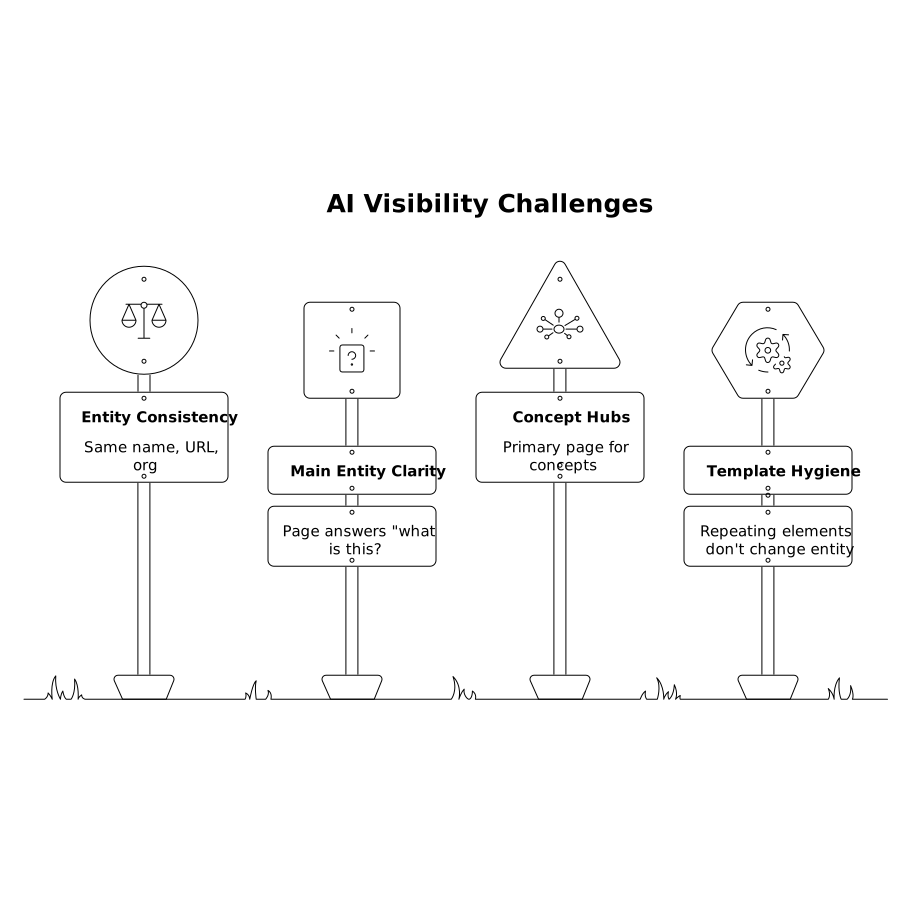
Prioritize these checks before chasing more content volume:
- Entity consistency audit: same name, same URL patterns, same organization references across the site.
- Main entity clarity: each page answers “what is this page about?” in both headings and structured data.
- Concept hubs: ensure important concepts have a primary page and aren’t split across thin posts.
- Template hygiene: repeating elements (author boxes, product CTAs, FAQs) should not accidentally change the page’s main entity.
A note on citability and duplicated assets
Another hidden failure mode is when your content is understood but not cited back to you because canonical signals or fingerprints are unclear. If you syndicate, republish, or reuse fragments, treat “what should be attributed to this URL” as part of your entity graph. If you work with syndicated content, it’s worth thinking through approaches like content fingerprinting for LLMs without losing citability so your authoritative source remains obvious.
What success looks like
When JSON-LD and your internal entity graph are working together, your pages become easier to classify, easier to cluster, and easier to retrieve as evidence. The outcome is not just “indexing.” It’s being consistently surfaced when users ask LLMs for recommendations, comparisons, definitions, and next steps—because the system can confidently tell what your pages are, not just what they say.
Vertical Video