
Why a “Things to Do Nearby” hub works without stealing traffic from room pages
Hotel websites often treat local attractions as a blog afterthought. But a dedicated “Things to Do Nearby” hub can become a reliable local SEO asset and a conversion assistant—if it’s structured to support room revenue, not compete with it. The goal is simple: capture high-intent searches like “things to do near [hotel]” or “events near [neighborhood] tonight,” then guide visitors toward booking paths that remain clearly about rooms and rates.
The biggest risk is cannibalization: you publish dozens of local pages, they start ranking for broad destination terms, and your core room pages lose visibility or confuse Google about the primary purpose of the site. The solution is entity-based internal linking, tight information architecture, and event schema that clarifies intent.
Start with a hub-and-spoke architecture built around entities
Think in entities, not keywords. Your hub is the parent page (for example, “Things to Do Near [Hotel Name]”), and each spoke is an entity page that represents a specific attraction category or individual place: a theme park, museum, beach, neighborhood, dining district, or venue.
Recommended structure
- Hub page: “Things to Do Nearby” overview with sections for top categories and seasonal highlights.
- Category pages: “Family attractions,” “Nightlife,” “Beaches,” “Shopping,” “Outdoor activities,” “Rainy-day ideas.”
- Entity pages: One page per high-value attraction/venue when search demand justifies it.
- Event layer: A curated “Events near the hotel” component that can live on the hub and/or on relevant venue pages.
This architecture makes it easy for search engines to understand topical coverage while giving users a clear path from inspiration to booking.
Write each page to answer a travel decision, not to rank for a city keyword
To avoid competing with your destination landing pages (or the room pages themselves), each attraction or category page should focus on helping a guest plan a stay. That means practical details and proximity signals rather than generic city copy.
What to include on attraction and category pages
- Distance and travel time: “12 minutes by car,” “18 minutes by I-Ride,” “walkable in 9 minutes.”
- Best time to visit: Morning vs. evening, weekdays vs. weekends, seasonal notes.
- Who it’s best for: Families, couples, business travelers, solo travelers.
- Ticket and planning tips: Parking, reservation windows, arrival time suggestions.
- A short “Stay strategy” block: A sentence or two that ties the activity to the hotel experience (without turning the page into an ad).
Keep the tone editorial. The page should feel like a concierge guide that just happens to sit on your hotel website.
Use entity-based internal linking to pass relevance in the right direction
Internal linking is where most hotel attraction content goes wrong. If every page links directly to the booking engine with the same anchor text, you create a messy network of repetitive signals that don’t help search engines interpret purpose. Entity-based internal linking uses descriptive anchors and a predictable pattern that clarifies page roles.
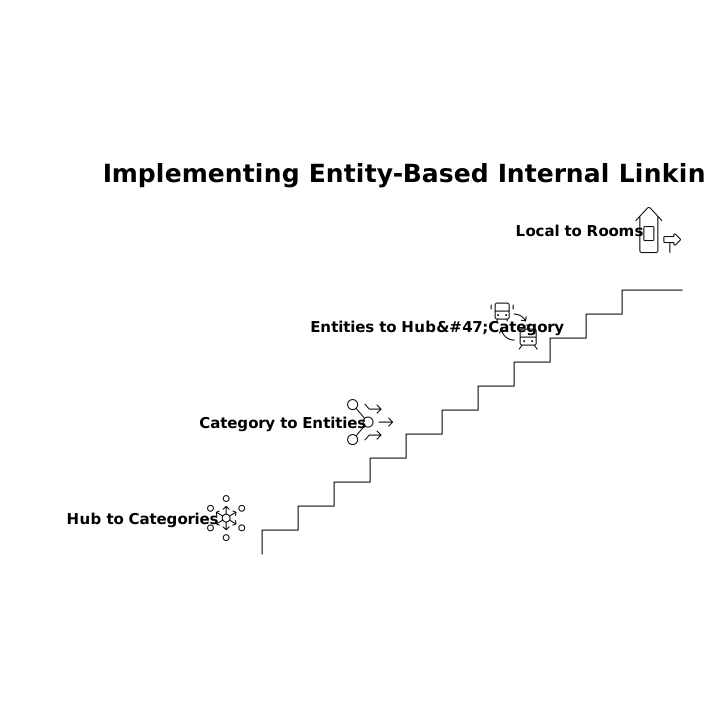
Internal linking pattern that supports rooms
- Hub → categories: Link using clear anchors like “family-friendly attractions near the hotel.”
- Category → entity pages: Link to individual attractions with the attraction name as anchor.
- Entity pages → hub/category: Include a “More nearby ideas” module linking back up the hierarchy.
- Local pages → room pages: Link selectively, only when it matches the traveler’s intent (e.g., “See our rooms for weekend stays near [venue]”).
When you do link to revenue pages, vary the anchors naturally: “rooms near [attraction],” “weekend stay options,” or “check availability.” Avoid forcing “book now” everywhere.
How to avoid cannibalizing your room pages
- Keep room pages as the authority for “rooms,” “rates,” and “suites” terms. Your attraction pages should not target “hotel in Orlando with suites” style queries.
- Use distinctive templates. A room page template and an attraction page template should look and read different, so intent stays clear.
- Control titles and headings. Attraction pages should lead with the attraction/entity, not the hotel category.
- Use breadcrumbs. Breadcrumbs reinforce hierarchy for users and search engines.
If you’re managing complex site sections (hotel content, guides, multi-location properties), the same discipline used in workflow design applies here: predictable structures reduce maintenance issues. This is similar in spirit to the clarity principles behind branching logic patterns that keep workflows maintainable, but applied to content architecture.
Add event schema without turning your hub into a thin event calendar
Events are a powerful local intent trigger, but a common mistake is creating dozens of short “event” posts that age out quickly, dilute crawl budget, and generate duplicate patterns across properties. Instead, integrate events as structured components within your hub and select venue pages.
Best practice: a curated, limited event module
- Feature a small number of upcoming events that are genuinely relevant to guests (festivals, concerts, conventions, seasonal markets).
- Keep a stable URL for your “Events near the hotel” section (either as a subpage or anchored section on the hub).
- Pair events with context: parking tips, best arrival times, and a “where to stay” note that links to rooms appropriately.
Where Event schema fits
Use Event structured data on pages where the primary content is truly about that event listing. If your hub contains an events section, you can mark up each event within the page as long as the content is visible and accurate. For events hosted at a venue that has its own entity page, the venue page can include a short “Upcoming at this venue” section with Event markup, while the hub aggregates only the top highlights.
Also consider Place or LocalBusiness schema for attraction pages where it’s appropriate. The point is clarity: room pages describe lodging offers; attraction pages describe places; event sections describe events. Clear schema roles reduce mixed signals.
Create conversion paths that feel helpful, not salesy
A high-converting hub doesn’t force bookings; it reduces uncertainty. Add conversion elements that match the traveler’s mindset at that moment.
Conversion elements that work well on nearby-things hubs
- “Plan your stay” cards tied to trip types (weekend, family, concert night, rainy-day itinerary).
- Map embeds showing clusters of attractions (helps users visualize proximity).
- Short itinerary blocks like “2 days near International Drive,” linking to relevant entity pages.
- Soft booking prompts that link to room pages with intent-matching anchors.
To keep your claims trustworthy (especially around distances, times, and seasonal notes), maintain a simple “content validation” checklist for updates. The mindset is similar to building verifiable content systems, like ground-truth snippet packs for verifiable AI claims, except here you’re verifying local facts that impact guest decisions.
Operational tips to keep the hub accurate and scalable
- Set update cadences: quarterly for evergreen attractions; monthly for event modules in peak seasons.
- Use content tiers: only build standalone entity pages for attractions with demand and conversion relevance.
- Standardize fields: distance, parking, hours, best time to visit, and “good for” tags.
- Track engagement: clicks from hub → room pages, and hub → booking flow, to ensure the hub supports revenue.
For hotels that want this done with strong hospitality context and clean technical execution, KiksMedia’s Orlando-based team blends tourism experience with performance-focused web builds and local search expertise. Reference details and service overview are available at kiksmedia.com.