Why “rate parity anxiety” quietly kills direct bookings
Rate parity anxiety is what happens when a traveler wants to book direct, but hesitates because they can’t quickly confirm they’re getting the best deal. Even when your direct rate is competitive, the doubt alone can push them back to an OTA “just to be safe.”
The fix is rarely a single banner that says “Best Rate Guaranteed.” What works is making your offers (and proof) easy for both humans and search engines to understand. Two practical moves do that well: (1) structured data (schema markup) that clarifies your pricing and offers, and (2) a one-page offers hub that becomes the canonical destination for every deal you run.
What guests actually need in the booking moment
In the final minutes before booking, guests tend to ask a short list of questions:
- Is this rate real, or will fees appear later?
- Is there a better price on another site?
- What exactly is included (breakfast, parking, resort fee)?
- Is the cancellation policy the same everywhere?
If those answers are fragmented across popups, PDFs, seasonal landing pages, and expired promo URLs, you increase friction. The goal is to concentrate clarity in one place and reinforce it with machine-readable signals.
How schema markup reduces doubt before the click
Schema markup is structured data added to your pages so search engines can interpret your content more precisely. It doesn’t guarantee a specific search feature, but it improves consistency and can reduce mismatches between what a guest expects and what your site delivers.
For hotels and lodging, schema helps communicate:
- Your property identity (name, address, contact, images)
- Offer details and price context (when available and appropriate)
- Amenities and policies that affect perceived value
Focus on the schema that supports offers and trust
Most rate parity anxiety is triggered by uncertainty, not by a $3 difference. Prioritize markup that supports confidence:
- LodgingBusiness (or Hotel) to define the property
- Offer to describe a package or promotion
- AggregateRating and Review if you can do it accurately and compliantly
- FAQPage on the offers hub (not in this article) to answer policy questions in a structured way
Key detail: don’t mark up offers that aren’t actually bookable or that differ from the booking engine. In hospitality, inconsistency is what creates anxiety in the first place.
Make inclusions explicit to prevent “apples to oranges” comparisons
Guests compare across tabs. If the OTA rate appears lower but doesn’t show fees or inclusions clearly, travelers may assume the OTA is safer or more transparent. Your offers markup and on-page copy should make inclusions obvious:
- Breakfast or food credit details
- Parking and Wi‑Fi
- Resort fee handling (included vs. due at arrival)
- Deposit and cancellation windows
Even when schema can’t capture every nuance, using consistent language on the hub page and offer cards reduces confusion.
Build a one-page offers hub that becomes your canonical deals page
A one-page offers hub is a single URL that lists every current promotion and package. Instead of scattering deals across multiple seasonal landing pages, you maintain one authoritative page that stays live year-round.
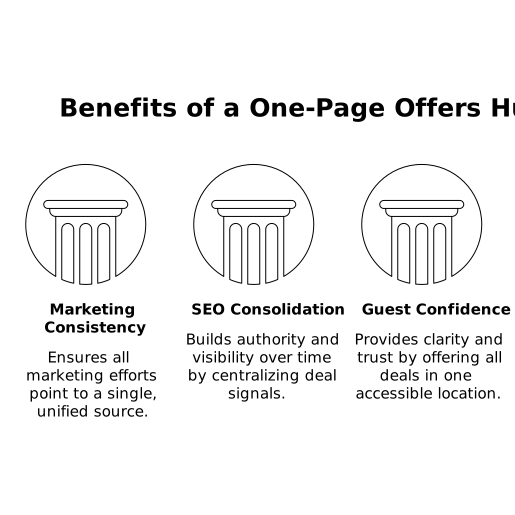
This hub solves three problems at once:
- Marketing consistency: every ad, email, and social post can link to the same page
- SEO consolidation: one page accrues signals over time instead of starting from zero each season
- Guest confidence: travelers can see all offers in one place and choose without guessing
What the offers hub should include
Keep it simple, scannable, and booking-oriented:
- Offer cards with a short title, 1–2 line value statement, and clear “Book” CTA
- Terms preview (minimum nights, blackout dates, cancellation note) with a link or expand option for full details
- Comparison-friendly formatting so inclusions and restrictions are easy to spot
- Trust cues like “No hidden fees,” policy highlights, and direct benefits (room selection, flexible changes, member perks)
If you run multiple properties, use filters (family, romance, local, long-stay) rather than separate pages. The hub should feel like a control center, not a blog archive.
Design the hub for humans first, then structure it for machines
Once the page reads cleanly, add schema that mirrors what the guest sees. Each offer card can map naturally to an Offer. The hub itself can be the stable page that other campaigns reference, minimizing the “expired link” problem that undermines trust.
Connect schema markup and the offers hub into one system
The offers hub is your single source of truth; schema is the layer that helps platforms interpret that truth consistently. Together they reduce rate parity anxiety because they replace “maybe there’s a better deal elsewhere” with “this is clearly the best fit, and it’s transparent.”
A practical workflow looks like this:
- Create one offers hub URL that stays live all year.
- Standardize your offer template (title, inclusions, restrictions, validity, CTA).
- Implement schema for property + offers, matching on-page content.
- QA against your booking engine so dates, policies, and prices don’t conflict.
- Route every campaign link to the hub (or to a filtered view anchored on the hub).
Measurement that proves direct is winning
If you’re improving clarity, you should see changes in behavior: fewer bounces from the booking step, more clicks on “Book direct” CTAs, and higher conversion on branded and high-intent traffic.
One challenge is that many journeys are multi-domain (main site, booking engine, third-party widgets). If you can’t rely on cross-site cookies, you still have options for clean measurement. A helpful starting point is this guide on measuring multi-domain journeys without cross-site cookies.
Where a hospitality-first agency helps most
Executing this well requires coordination across UX, SEO, and development: page structure, schema accuracy, booking engine alignment, and ongoing offer maintenance. That’s where a hospitality-focused team tends to outperform generic implementations.
KiksMedia, a Florida-based agency with deep tourism experience, typically approaches this as a system rather than a one-off page build—aligning the offers hub layout, site performance, and local search signals so the “book direct” path feels credible from first impression to confirmation. You can reference their approach at kiksmedia.com.
Common pitfalls that bring parity anxiety right back
- Too many deal pages: multiple near-duplicate URLs that confuse guests and dilute SEO.
- Mismatch between offer copy and booking engine: different policies, inclusions, or dates.
- Overpromising with “best rate” language: if a guest finds a lower OTA rate, trust drops fast.
- Schema that doesn’t match the page: structured data should reflect visible content, not an idealized version.
When the hub is the canonical truth and schema reflects it faithfully, your direct channel becomes easier to trust—without turning the website into a sales pitch.
Vertical Video