
Why internal jobs deserve stricter database access
Most data incidents in internal systems don’t start with a sophisticated external attacker. They start with something mundane: a cron job that quietly kept a long-lived database password in an environment variable, a CI runner that reused the same secret across projects, or a “temporary” admin role that never got removed.
Internal jobs—ETL steps, backfills, reconciliation scripts, billing syncs, reporting tasks—often run unattended and on schedules. That makes them easy to forget and hard to audit. If they hold static credentials, the blast radius of a single leak can be large and long-lived.
Least-privilege, ephemeral access changes the default. Each job gets only the permissions it needs, for only the time it needs them. Credentials expire automatically, and rotation happens continuously without humans creating tickets.
The target model in one sentence
For each run of an internal job: authenticate the workload, mint short-lived database credentials scoped to a minimal role, execute, and let the credentials expire—while rotation is handled by policy and automation, not manual secret updates.
Core building blocks
1) Workload identity, not shared secrets
Ephemeral access starts with a strong way to identify the job itself. Typically that means a workload identity provided by your runtime:
- Kubernetes service accounts (often paired with OIDC)
- AWS IAM roles for tasks (ECS/Fargate), instances, or GitHub Actions via OIDC
- GCP service accounts / Workload Identity Federation
- Short-lived CI identities (OIDC tokens) instead of repository-level shared secrets
The idea is simple: the job proves “who it is” using an identity the platform can attest to. From that identity, you derive authorization to mint database access.
2) Database roles aligned to job intent
Least privilege is much easier when roles are designed for specific job intents. Instead of “app_user” or “admin,” create roles like:
- billing_reconcile_reader: SELECT on billing views only
- etl_loader: INSERT into staging tables, EXECUTE on a narrow set of procedures
- backfill_writer_orders: UPDATE specific columns on a specific table
Keep these roles stable and explicit. Ephemeral credentials should map onto these roles, not the other way around.
3) A credential broker that issues short-lived DB access
You need a mechanism that can mint database credentials on demand, with a TTL. Common approaches include:
- Cloud-native DB auth: e.g., IAM-based database authentication where supported, producing tokens that expire quickly.
- Secrets brokers: systems that create dynamic database users or generate short-lived credentials with automatic expiration.
- Custom “broker” service: a minimal internal service that authenticates the job via OIDC/IAM and then issues credentials (or session tokens) according to policy.
Regardless of the implementation, enforce: short TTLs (minutes, not days), strong auditing, and tightly controlled mappings from workload identity to database role.
Designing the flow end to end
Step 1: Authenticate the job run
At runtime, the job obtains an identity token from the platform (OIDC token, instance/task metadata credential, etc.). This token should be unique to the job’s execution context and verifiable by your broker.
Step 2: Authorize with policy, not convention
Authorization should be explicit: “job A in environment prod can request role X on database Y for up to 10 minutes.” Avoid naming conventions as security boundaries.
This is also where you enforce environment separation: a staging job identity must not be able to mint production database access, even if it runs the same code.
Step 3: Mint short-lived credentials
The broker issues one of the following:
- A short-lived token usable as the database password
- A dynamically created database user with an expiry and required role grants
- A signed certificate (for mTLS-based database auth) with a short validity window
Make the TTL shorter than your typical job runtime where possible, and refresh only when required. Jobs that run for hours should be redesigned to segment work into smaller chunks, each with fresh credentials.
Step 4: Execute and log with correlation
Ephemeral credentials are only half the story; observability is what turns it into an operationally safe system. Every issuance should be logged with:
- Workload identity (who requested it)
- Database and role granted
- TTL and issuance time
- Run ID / trace ID so DB activity can be correlated to the job execution
If you already instrument DAG workflows, extending span-based observability to include “credential minted” and “DB connected” events makes incident response much faster. (If you’re working on this kind of per-step rigor, the patterns in Enforcing Per-Step SLOs in DAG Workflows with OpenTelemetry Spans translate well to credential and access SLOs too.)
Step 5: Let credentials expire; rotate automatically
The cleanest rotation plan is the one you never manually run. Prefer systems where credentials naturally expire and are recreated per run. For cases where you still have a long-lived secret (for example, a bootstrap credential used only by the broker), treat rotation as a scheduled, automated process with alerting on failures.
How to apply this to scheduled jobs and DAGs
Internal jobs are often chained: extract → transform → load → validate. The least-privilege approach should mirror the DAG:
- Each node gets its own role and TTL.
- Downstream steps should not inherit upstream credentials.
- Prefer separate database roles per step rather than a shared “pipeline role.”
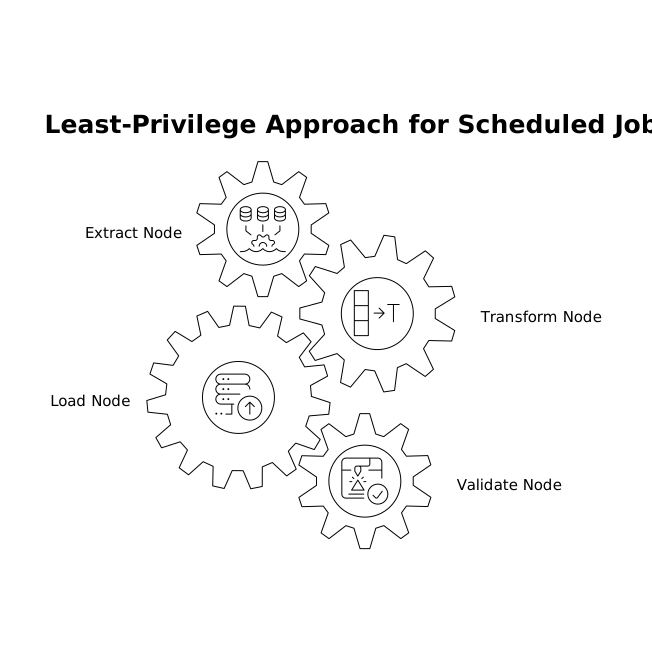
That makes rollbacks safer too. If a validation step only needs read access, it can’t accidentally mutate production tables even if the code changes.
Practical guardrails that prevent “privilege creep”
Set a permission budget per job
When a job requests broader permissions, require a review. Treat privilege increases like schema migrations: intentional, visible, and traceable.
Reduce the number of places secrets can live
Even with ephemeral access, you’ll still have configuration: endpoints, database names, role identifiers. Centralize these in one platform and keep them out of ad-hoc shell scripts.
Make failure safe
If credential minting fails, the job should fail closed. Don’t implement “fallback to static password” as an escape hatch.
Where Windmill fits in this architecture
Windmill is designed for internal jobs, workflows, and operational tooling where security and auditability matter. In practice, teams use windmill.dev to standardize how scripts run (across languages), how schedules and webhooks trigger execution, and how credentials are managed without sprinkling secrets across multiple runtimes.
A useful pattern is: keep the credential-brokering logic as a small, auditable script or service, then have workflows request ephemeral credentials at the step that actually needs database access. That keeps the blast radius narrow and the code path observable, while still letting engineers move quickly on internal automation.
Common implementation pitfalls
Over-scoped roles “just to stop the paging”
If on-call pressure leads to granting broad permissions, you’ll end up back with effectively static admin access—just on a timer. Treat role design as part of the job’s contract.
TTL mismatched to runtime reality
If TTL is too short, jobs fail mid-run; too long, you lose the benefit. Start with 10–30 minutes for most internal tasks, then tune per workflow step.
No clean separation between environments
Staging identities must not mint production credentials. Enforce separate trust domains, separate brokers, or at least separate policy sets and audit streams.
A checklist you can use this week
- Inventory internal jobs that touch databases and locate all static credentials.
- Define job-specific DB roles with minimal grants.
- Adopt workload identity (OIDC/IAM/K8s service accounts) for each job runner.
- Introduce a broker that issues short-lived DB access with a strict TTL.
- Add correlation IDs and logs for every issuance and connection.
- Remove fallback static secrets and verify failure is closed.
Done well, this reduces incident scope, makes audits easier, and turns credential rotation from a calendar reminder into a property of the system.