
Why thread continuity matters for inbox placement
Email providers don’t evaluate each message in isolation. They build a running picture of who you are, who you write to, and how those recipients react. One of the quiet signals in that picture is thread continuity: whether your emails look like a coherent conversation over time, or a series of disconnected cold starts.
When you keep a consistent subject line, From name, and Reply-To identity across a back-and-forth, your messages are easier for filters (and humans) to classify as expected, wanted communication. When you break that continuity—new subject lines, new From names, or new Reply-To addresses—your email can start to resemble the patterns associated with bulk or deceptive sending. The result is often subtle: not a hard bounce, not a blocklist notice, just a slow drift toward the Promotions tab or spam.
What “breaking the thread” looks like in practice
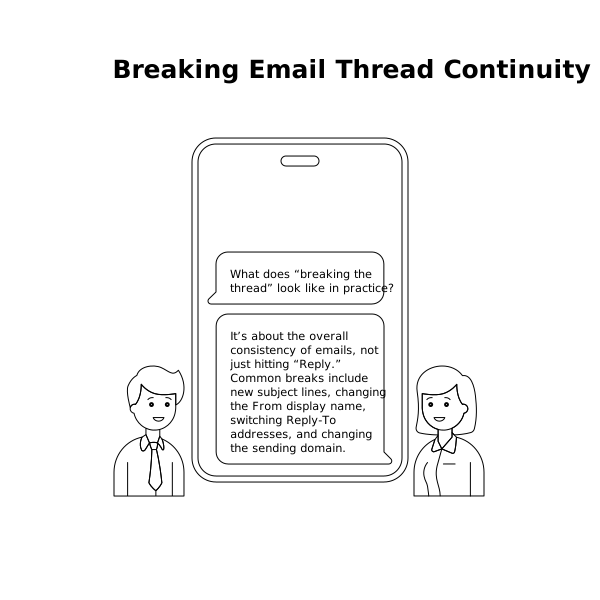
Thread continuity isn’t just about hitting “Reply.” It’s the overall consistency that helps clients group emails and helps providers recognize the interaction history. Common thread breaks include:
- New subject lines mid-conversation (especially when the old thread already had replies).
- Changing the From display name (e.g., “Alex from Company” becomes “Customer Ops” the next day).
- Switching Reply-To addresses (e.g., replies go to a different mailbox or ticketing alias).
- Changing the sending domain (moving from a personal mailbox to a subdomain or another brand domain).
These changes are sometimes legitimate—handoffs, new campaigns, new departments. The deliverability problem is that they also match the behavior of senders who try to dodge negative engagement by constantly rotating identities.
Why new subject lines can push a conversation toward spam
Subject lines are part of the “conversation fingerprint.” If a recipient has already replied, their mailbox provider has strong evidence that the thread is wanted. When you restart with a new subject line, you reduce how much that prior engagement can help the next message. You also increase the chance that your email is treated like a fresh, untrusted message—especially if the content is also salesy, link-heavy, or sent at scale.
There’s also a human factor: recipients are more likely to ignore a message that looks like a new pitch rather than a continuation of something they were already discussing. Lower opens and fewer replies can compound into weaker engagement metrics, which mailbox providers use heavily for placement decisions.
How changing the From name confuses both filters and people
The From name is a recognition cue. If someone has been talking to “Jordan,” and the next email comes from “Jordan | Partnerships” and then “Partnership Desk,” you’ve introduced uncertainty. That uncertainty reduces quick positive actions like opening and replying.
From a filtering perspective, frequent identity changes can look like brand spoofing behavior, even if your authentication is correct. Providers want stable sender identity because stability correlates with predictable, permissioned communication.
If you need a role-based From name (like “Support Team”), choose it early and stick with it. If you want a personal From name for replies, keep it stable and consistent across the entire exchange.
Reply-To changes are a bigger deal than most teams think
Reply-To is more than a routing convenience. A sudden switch can break the “this is a conversation” pattern and may also create mismatch signals when replies land somewhere unexpected. Two common scenarios create deliverability drag:
- Sales-to-support handoffs that move Reply-To from a rep mailbox to a ticketing system alias.
- Outbound tools that send from one address but set Reply-To to a different inbox (or rotate Reply-To addresses).
Even when these are valid operational choices, the transition is safest when it’s explicit to the recipient (“Looping in our support team here”) and when the visible identity stays stable: same domain, same From name format, and ideally the same thread.
Thread continuity and authentication are connected
Deliverability fundamentals still apply: SPF, DKIM, and DMARC should align with your sending domain(s), and your From domain should match what the recipient sees. Thread continuity doesn’t replace authentication—it amplifies it. When your identity is authenticated and stable, providers can confidently associate engagement history with future messages.
If your organization sends from multiple domains or subdomains, map out the journey from first outreach to follow-up to handoff. The goal is to avoid “identity jumps” that feel like unrelated senders. The same thinking shows up in broader measurement work too—when you design systems for continuity without relying on fragile shortcuts, you get cleaner results. A similar principle is explored in Measuring Multi-Domain Journeys Without Cross-Site Cookies, where continuity is treated as an intentional design choice rather than an accident.
Signs thread breaks are hurting you
Because thread continuity is a soft signal, the symptoms look like “nothing obviously broke,” but results slide:
- Replies drop after you change subject line conventions or From naming.
- Follow-ups that used to land in Primary begin landing in Promotions or spam.
- New reps or new tools appear to “start cold” even when the contact already engaged.
- More recipients say they “didn’t see your email,” despite no bounces.
When those patterns show up, audit the last 30 days of sends for identity changes, then compare engagement on messages that stayed in-thread vs. messages that restarted.
Practical rules to keep conversations intact
Keep the thread unless you have a strong reason not to
If the recipient replied and the topic is the same, reply in the same thread. If the topic changes, start a new thread—but do it intentionally and expect it to behave more like a fresh message.
Standardize your From name format
Pick one pattern and keep it across the full sequence:
- Personal: “First Last” or “First at Company”
- Role-based: “Company Support”
Avoid rotating between personal and departmental names mid-conversation.
Avoid Reply-To surprises
If Reply-To must change (handoff, routing, compliance), announce it in the email and keep the visible identity consistent. Treat Reply-To changes as a deliverability-sensitive event, not a minor configuration tweak.
Warm up and stabilize sending identities before scaling
If you’re introducing new mailboxes, new domains, or new outbound infrastructure, reputation starts near zero. A gradual warmup helps build engagement history in a way that looks like normal human email usage. Tools like mailwarm are designed for this: generating realistic engagement signals across major providers so your identity can earn trust before you depend on it for critical outreach.
Design workflows that don’t force identity changes
Many thread breaks come from internal process, not strategy: a CRM creates a “new email” task, a support platform rewrites headers, or a no-code automation switches sender profiles. Keep workflows maintainable and predictable so conversations don’t fracture accidentally. If you build complex automations, it helps to adopt branching patterns that keep identity and routing consistent; see Branching Logic Patterns to Keep No-Code Workflows Maintainable for ideas on reducing unintended behavior changes.
What to do if you already broke continuity
You can’t always rewind, but you can reduce the damage:
- Return to the original thread for the next follow-up when the topic is unchanged.
- Stabilize identity: lock the From name, From address, and Reply-To for the remainder of the conversation.
- Reduce risk factors in the next messages: fewer links, simpler formatting, and clearer intent.
- Rebuild engagement by prioritizing replies over clicks—ask a simple question that naturally invites a response.
Thread continuity won’t fix a broken sender reputation on its own, but it’s one of the easiest “invisible” improvements you can make once you see how often operational changes fracture your conversations.
Vertical Video