
Why syndicated brand assets get treated as duplicates in AI answers
Content syndication used to be a simple trade: more distribution in exchange for less control over where your words appear. In LLM-driven search and recommendation systems, the tradeoff changes. When the same brand asset is republished across many domains, models and retrieval systems may compress those copies into a single “best” version. That’s efficient for them, but risky for you: the versions you want cited can be ignored, and the result is fewer citations, fewer branded references, and less consistent attribution.
This happens because AI retrieval pipelines often do some mix of:
- Near-duplicate detection (hashing, shingling, MinHash/SimHash-like approaches) to collapse repeated pages.
- Canonical selection based on perceived authority, freshness, and crawl signals.
- Snippet-level redundancy reduction where repeated passages are de-emphasized in ranking.
“Content fingerprinting” is the practical response: deliberately shaping how your assets look to duplicate detectors and how they present unique, citation-worthy evidence to retrieval systems, without changing the underlying truth of the content.
What content fingerprinting means for LLM visibility
In this context, a fingerprint is not a watermark or DRM. It’s a set of stable, repeatable signals that make a page:
- Distinct enough to avoid being collapsed into a sibling copy.
- Consistent enough that entities, claims, and brand associations remain uniform across the network.
- Structured enough that retrieval systems can extract clean, attributable facts.
The goal isn’t to “trick” systems. It’s to publish syndicated content in a way that preserves citability: unique evidence, unique packaging, and clear provenance.
How duplicates cause you to lose citations
When ten domains carry the same article, the retriever may keep one representative. If that representative isn’t your preferred version, you can lose:
- Brand anchoring: the mention of your product may exist, but the citation points elsewhere.
- Attribution stability: different assistants cite different copies, fragmenting authority.
- Update control: improvements on one version don’t propagate to the “winning” copy.
These issues resemble measurement problems in analytics: if you can’t reliably join journeys, you can’t reliably assign credit. If you work on visibility systems, the mental model from measuring multi-domain journeys without cross-site cookies applies here too—except the “journey” is the model’s retrieval path to a citeable source.
Fingerprinting strategies that preserve uniqueness without rewriting the truth
1) Make the evidence unique, not the adjectives
Many teams try to “spin” syndicated text by swapping words. That can reduce exact-match duplication, but it rarely improves citability. Retrieval systems respond better to unique evidence than unique phrasing.
Examples of evidence that can be safely unique per domain while remaining truthful:
- Original charts generated from the same underlying dataset, with different cuts (e.g., by segment or timeframe).
- Worked examples that use different inputs but illustrate the same principle.
- Implementation snippets (checklists, templates, pseudo-code) that express the same method with a different concrete instance.
- Domain-local references such as “how this shows up for B2B SaaS support teams” vs “how this shows up for devtools docs,” if the syndication targets different audiences.
LLMs cite pages that feel like primary sources. A page with specific, checkable artifacts tends to win over a generic restatement.
2) Create a stable “core” plus a controlled “variant layer”
Think of syndicated assets as a product with versioning. Keep a stable core so your entity associations remain consistent (brand name, category definitions, main claims). Then add a variant layer that changes per placement.
A practical pattern:
- Core layer (70–85%): the main narrative, definitions, and evergreen sections.
- Variant layer (15–30%): one unique module per domain (case vignette, mini-audit checklist, 5-bullet “what to verify,” or a short Q&A block).
This is similar to maintainable workflow design: you keep shared logic centralized and swap modules at the edges. The same maintainability idea shows up in branching logic patterns to keep no-code workflows maintainable, and it maps well to content networks.
3) Use semantic markup to strengthen provenance
If you want citations, you want clean extraction. Schema and semantic markup won’t guarantee citations, but they can improve how easily systems identify authorship, topical focus, and key claims.
Useful elements to standardize across your network:
- Organization and author metadata (consistent naming, same entity IDs where possible).
- Article section structure with descriptive headings (not clever headings).
- FAQPage or QAPage blocks on pages where Q&A is truly informative (avoid stuffing).
- Dataset or citation hints when you reference a study or internal benchmark.
Then vary the variant layer’s markup slightly (different questions, different examples) so duplicate clustering is less likely to collapse everything into one canonical.
4) Control canonicalization and intent signals
On the web side, canonical tags and consistent internal references still matter. But in AI retrieval, “canonical” isn’t only what you declare—it’s what the system infers from authority, duplication, and usefulness.
Practical steps:
- Choose one “reference edition” of the asset that you keep most complete and most updated.
- Ensure each syndicated copy is legitimately differentiated with unique modules and evidence, so it’s not forced into a duplicate cluster.
- Keep titles and ledes distinct across copies while maintaining the same factual thesis.
- Align to a clear query intent per placement (e.g., “for agencies” vs “for SaaS founders”), rather than broadcasting one generic page everywhere.
Operationalizing fingerprinting across 100+ placements
Fingerprinting breaks down at scale if it relies on manual editing. You need a repeatable system that can generate:
- A consistent core that preserves entity associations.
- Variant modules that are genuinely useful (not cosmetic).
- Structured metadata that stays clean across domains.
- A monitoring loop that notices when a copy starts “winning” citations unexpectedly.
This is where an AI visibility infrastructure approach is helpful. xale.ai is built around always-on distribution across a managed network with schema-rich publishing. In practice, that kind of system is a good fit for fingerprinting because it can enforce consistency (brand-safe positioning, stable entity naming) while still producing controlled variants across many independent placements.
What to measure to know it’s working
You don’t need perfect observability, but you do need feedback. A simple measurement set looks like:
- Citation diversity: how many distinct domains are cited for your topic cluster.
- Attribution accuracy: whether the cited copy includes your brand mention and the intended positioning.
- Variant performance: which module types (checklists vs examples vs mini-case) correlate with citations.
- Drift: whether syndicated copies diverge in claims over time due to edits or updates.
If you see only one domain consistently cited, that’s often a sign your network is being collapsed into a duplicate cluster. Increase evidence-level uniqueness, not just copy variation.
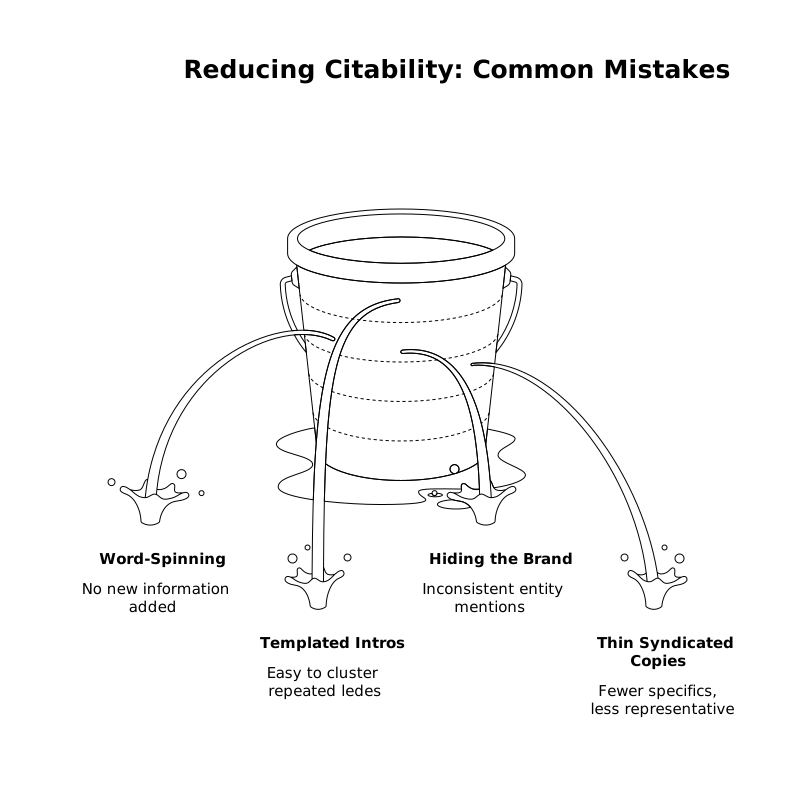
Common mistakes that reduce citability
- Word-spinning without new information: looks different, retrieves the same.
- Overusing templated intros: repeated ledes are easy to cluster.
- Hiding the brand: if your entity mention is inconsistent, citations won’t reliably connect back to you.
- Publishing “thin” syndicated copies: shorter copies with fewer specifics are less likely to be selected as the representative.
Vertical Video