
Why web-to-app handoffs break ROAS more often than teams admit
The “conversion location gap” happens when the ad click is observed in one place (a browser, an in-app webview, an email client) but the conversion is recorded somewhere else (a native app event, a different domain, or a CRM record). On paper, each system looks accurate. In reporting, though, performance fragments: paid social shows clicks with “missing” purchases, mobile attribution shows installs with “unknown” campaigns, and the CRM shows revenue that never ties back to spend.
This isn’t a single bug. It’s the predictable result of cross-channel journeys being stitched together by identifiers that don’t survive handoffs.
What creates the conversion location gap
1) The referrer and URL context disappear
On the web, attribution often leans on URL parameters (UTMs, gclid/fbclid) and referrer signals. When a user taps “Open in app,” those details can vanish unless you explicitly pass and store them. Even when you do, the app may not treat them as trustworthy or persistent, especially across delayed conversions.
2) Deep links don’t guarantee campaign continuity
Deep links are great at sending a user to the right screen, but they’re not automatically great at preserving marketing context. A link can open the app correctly while still failing to map the click to the eventual in-app purchase event—particularly when:
- the app is already installed and opens instantly (no install flow to “anchor” attribution),
- the deep link passes no campaign payload beyond the destination path,
- the conversion happens hours or days later, after sessions reset.
3) Multiple domains split the journey into separate “users”
Many brands run product marketing on one domain, checkout on another, help center on a third, and account management behind a subdomain. Each boundary increases the chance that session identifiers reset or consent rules change. Without careful instrumentation, your analytics platform may count these as separate users and separate acquisition sources.
If you’re dealing with this already, the practical patterns for multi-domain tracking without relying on third-party cookies are covered in Measuring Multi-Domain Journeys Without Cross-Site Cookies.
4) CRM conversions rarely carry click-level identifiers
In B2B and high-consideration B2C, the “real” conversion might be an opportunity created, a contract signed, or a retained subscription—events that live in a CRM and appear long after the click. Those CRM objects typically store email, company, or a lead ID, but not the original click ID or deep link payload unless you designed for it.
How the gap shows up in reporting
Teams usually notice the conversion location gap as one of these symptoms:
- Platform mismatch: ad platforms claim conversions that analytics can’t see, or vice versa.
- Web ROAS drops after “Open in app” improvements: better app adoption looks like worse web performance.
- Inflated “Direct” or “Unassigned” traffic: marketing context isn’t carried across boundaries.
- Under-counted assisted conversions: the first touch is on web, the purchase is in-app, and no system connects them.
A practical reconciliation model across web, app, and CRM
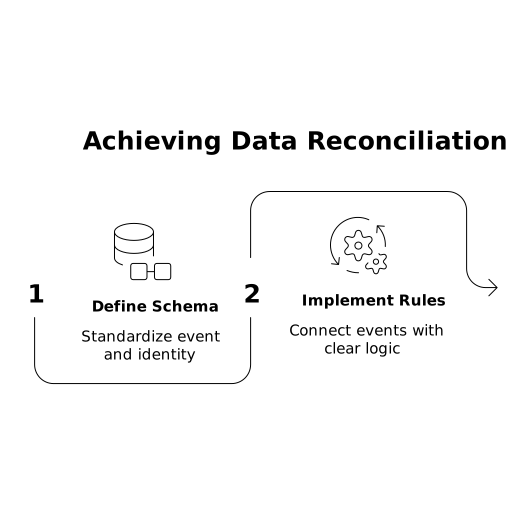
The goal is not to force every tool to agree perfectly. The goal is to create a defensible chain of evidence that lets you connect events across locations with clear rules.
Step 1) Define a canonical event and identity schema
Start by writing down what a “purchase,” “lead,” and “qualified lead” mean across your stack. Then define the minimal identifiers that must travel with those events. Typical fields include:
- Event identity: event_name, event_time, event_id (dedupe key)
- User identity: anonymous_id, customer_id, email_hash (when consented)
- Attribution context: utm_source/medium/campaign, click_id (gclid/fbclid), referrer_domain
- Location context: domain/app_id, platform (web/iOS/Android), environment (prod/stage)
Canonical schemas also reduce accidental “tool confusion” where one system interprets the same field differently than another. If you work with many integrations and automated pipelines, it’s worth adopting strict naming and validation rules similar to the ideas in Mitigating MCP Tool Confusion Attacks with Canonical Schemas and Input Normalization.
Step 2) Create a handoff token that survives the jump
When a user goes from web to app, you need a bridge. A common approach is a short-lived handoff token:
- Generate a token on the web when the user clicks “Open in app.”
- Store the marketing context server-side keyed to that token (UTMs, click IDs, landing page, timestamp).
- Pass the token through the deep link.
- On first app open, exchange the token for the stored context and attach it to the app user/session.
This avoids stuffing sensitive or long attribution payloads directly into the URL while giving you a reliable join key.
Step 3) Use event_id and deterministic deduplication rules
Duplicate counting is a quiet contributor to ROAS confusion. The same purchase can be logged by:
- client-side web tracking,
- server-side purchase confirmation,
- app purchase event,
- payment provider webhooks,
- CRM revenue updates.
Pick one “source of truth” for revenue recognition (often the server confirmation or payment webhook), then dedupe everything else against it using a stable event_id (order_id is usually the best candidate). Your BI model should make duplicates impossible by design.
Step 4) Decide what gets attributed where (and document it)
Cross-channel truth requires explicit rules. Examples:
- If a purchase happens in-app but has a valid handoff token from a web click within 24 hours, attribute to the web campaign.
- If the app install is attributed to a mobile network but the user’s first product view started on the web, treat it as an assisted conversion in reporting.
- If the CRM opportunity is created without click IDs, backfill campaign context from the earliest known session tied to that lead’s identity (with consent constraints).
These policies won’t satisfy every platform’s internal reporting logic, but they will give your team one consistent operational model for budget decisions.
Step 5) Normalize and deliver the data to a single analysis-ready layer
Once you can join events across locations, the next bottleneck is inconsistent definitions across tools: different currency handling, campaign naming drift, and mismatched metrics. This is where marketing data infrastructure matters.
Funnel.io is designed for this layer: collecting performance data from ad platforms, analytics, and CRMs, then normalizing it into an analysis-ready source of truth. With standardized fields and transformations (naming harmonization, currency conversion, KPI calculations), reconciliation becomes something you can maintain—rather than a one-off spreadsheet rescue.
What to monitor so the gap doesn’t reopen
- Handoff success rate: percent of “Open in app” clicks that result in a token exchange.
- Token match window: how often conversions fall outside your attribution window.
- Dedupe rate: number of duplicates prevented by event_id rules.
- Unassigned share: trend of “Direct/Unassigned” by platform and domain.
- Schema drift: new campaigns or sources that don’t map to your canonical naming.
When you treat the web, app, and CRM as different “conversion locations” that need explicit joins, ROAS becomes less about arguing which dashboard is right and more about whether your identity and event design is complete.